
Your First Steps Beyond the Home Airport

You’ve done your homework. You’ve flown your planned route with a map to test how practical it really is (revision 3, perhaps?). Ideally, you’ve also flown cross-country in a two-seater with an experienced pilot—talking through judgment, decision-making, and planning in real time. If not, that experience is invaluable. (I’m always available at Sky Sailing in our S10vt.)
Another effective method is lead-and-follow. I’ve used this successfully with more advanced students. The main limitation is increased radio chatter and less opportunity for in-depth discussion compared to a two-seater. I remember Danny Sorenson describing how he would fly an ASW-24 with gear down, and spoilers cracked just to stay with a 1-26—creative solutions like that make it work.
As students gain experience, I transition to a “drag and drop” approach. After the first leg (typically an out-and-return), I peel away and let them complete the flight independently. Out-and-returns also tend to feel less intimidating when building distance from the airport. This comes after practicing smaller triangles while always keeping the home airport within glide.
A good next step is to work with a “go/no-go” point toward another airport. Fly out to that point. When conditions allow you to confidently make the next airport, commit—leave home behind and continue forward. Don’t worry about returning until you’re back at a point where you can clearly make it home again. Since you remain within glide of the alternate airport, the risk stays low (with the primary consideration being a landing there). Be especially mindful of “get-home-itis”—the urge to push for home when you’re below your go/no-go margin.
This same decision framework can apply to fields, but it requires more caution. Off-airport landings can be performed safely and routinely, but you are still landing somewhere not purpose-built for aircraft. That alone can increase stress, which often degrades flying performance. Stay calm and stay disciplined.
If you’re planning to go from field to field, you need a higher level of confidence in your landing skills and a solid understanding of field selection.
One instructor used to say, “You’d better have walked it before you roll on it.” While not always practical, the principle holds—unknown hazards like wires can exist. At the WGC in Finland, we walked several fields within 10 km of the airport. Many were small, and given the likelihood of arriving low after a failed final glide, that firsthand knowledge mattered.
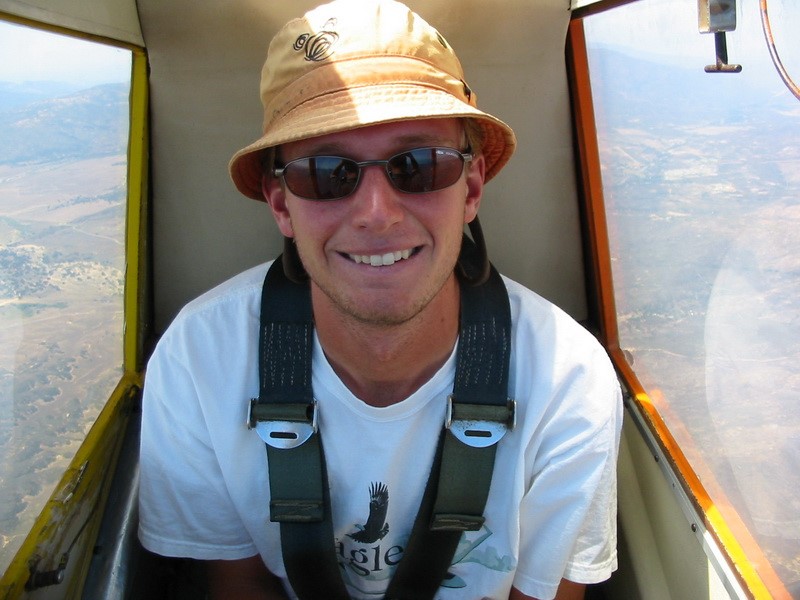 Garret Willat holds a flight instructor rating with over 8000 hours in sailplanes. His parents have owned Sky Sailing Inc. since 1979. He started instructing the day after his 18th birthday. Since then, Garret has represented the US Junior team in 2003 and 2005. He graduated from Embry-Riddle with a bachelor's degree in Professional Aeronautics. Garret represented the US Open Class team in 2008 and 2010 and the Club Class team in 2014. Garret has won 3 US National Championships.


